Roof rats (Rattus rattus) exploit citrus groves and mature palm canopies across suburban Chandler neighborhoods like Fulton Ranch, Pecan Grove, and Ocotillo, utilizing overhead power lines and tile roof offsets to…
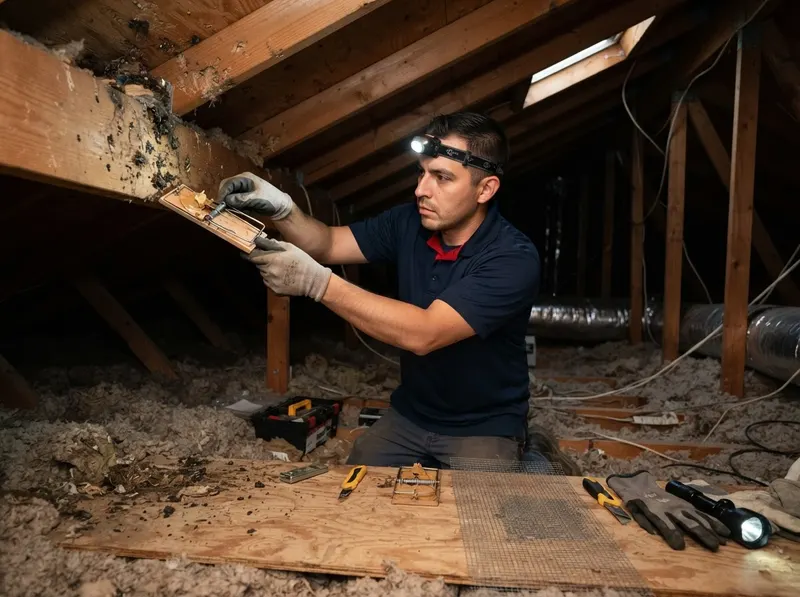
Roof rats (Rattus rattus) exploit citrus groves and mature palm canopies across suburban Chandler neighborhoods like Fulton Ranch, Pecan Grove, and Ocotillo, utilizing overhead power lines and tile roof offsets to enter attics. Unlike subterranean Norway rats, roof rats are agile climbers requiring an entry gap of merely 0.5 inches, roughly the diameter of a standard nickel. Structural remediation prioritizes physical barrier fortification over chemical baiting. Exterior poison bait boxes frequently lead to poisoned rodents expiring inside double-drywall dead air spaces or beneath deep fiberglass batt insulation, generating severe decomposition odors and secondary carpet beetle infestations. A mechanical containment protocol secures 1/4-inch 23-gauge galvanized hardware cloth over dormer vents, Spanish barrel tile roof corbels, and plumbing stack penetrations, physically terminating access from adjacent tree lines near Bear Creek Golf Complex and Veterans Oasis Park.
Attic trapping requires sequential mechanical harvesting using expanded-trigger snap traps calibrated specifically to attic runway paths. Standard store-bought rodent repellents, ultrasonic emitters, and mothballs fail against established colonies nesting near water heater platforms or air handler plenums in Warner Ranch or Sun Groves residences. Remediating the structure means addressing the structural hazards created by gnawing behavior. Because roof rat incisors grow at an average rate of 4 to 5 inches per year, rodents gnaw constantly on polybutylene plumbing lines and low-voltage Romex electrical insulation, creating hidden attic fire risks. Trapping without architectural sealing leaves open entryways for secondary colonies moving along the Consolidated Canal corridor during seasonal citrus harvest drops. Combining rigid perimeter metal exclusion with monitored mechanical traps removes the active population within 7 to 14 days while preventing reinvasion.
Homeowners weighing isolated DIY snap trapping against complete structural remediation trade immediate front-end savings for ongoing structural damage. Setting unmonitored hardware store traps without sealing roof transitions leads to trap shyness, where intelligent alpha rodents avoid triggered mechanisms entirely. Structural remediation resolves the access architecture permanently. 1. An on-site diagnostic inspects the entire roof junction, tile eaves, and attic interior for fecal density and rub marks. 2. Technicians install rigid metal flashings, weep-hole screens, and custom-cut hardware cloth across every aperture exceeding one-quarter inch. 3. Mechanical trap arrays are placed along identified structural joist runs and monitored over structured intervals until capture rates drop to zero.
Every job gets a firm, written price after a free on-site visit.
Tell us about your roof rat attic trapping & structural remediation job in Chandler and we'll send a clear, written quote, usually the same day.
 Iron Mesa Pest Control