Chandler foundations predominantly feature post-tension monolithic slabs or shallow stem walls that interact directly with dense, calcareous caliche soil. In communities such as Fulton Ranch, Ocotillo, and Sun Groves,…
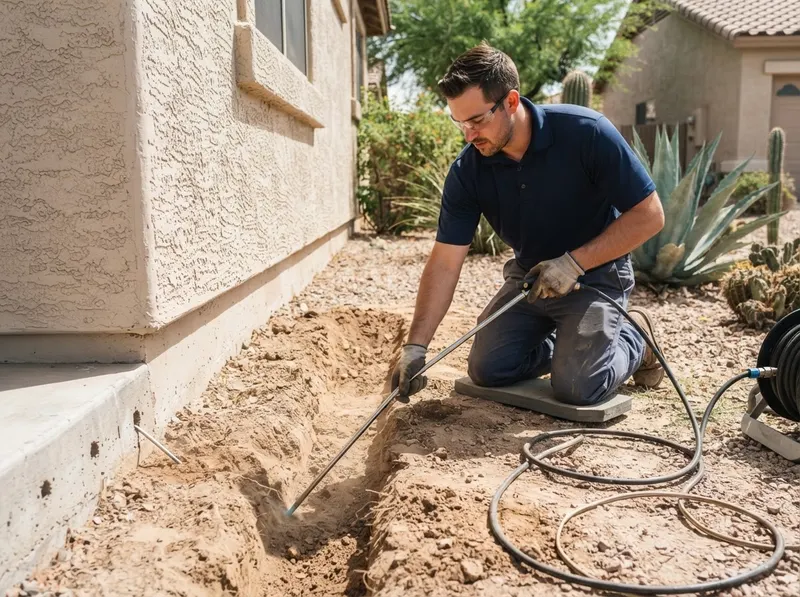
Chandler foundations predominantly feature post-tension monolithic slabs or shallow stem walls that interact directly with dense, calcareous caliche soil. In communities such as Fulton Ranch, Ocotillo, and Sun Groves, irrigation runoff from manicured turf drives subterranean termites upward along exterior footing edges. Subterranean termite soil trenching involves excavating a continuous 6-inch by 6-inch trench directly against exterior stem walls, followed by the hydraulic injection of non-repellent termiticide down to the footer depth. For adjoining flatwork like covered patios in Circle G at Riggs Homestead or paver driveways in Fox Crossing, slab abatement requires drilling precise half-inch access ports spaced 12 inches apart through the concrete to treat the compacted gravel base beneath, sealing every port with non-shrink hydraulic masonry plugs once the injection finishes.
Selecting liquid chemical trenching over surface bait stations provides immediate, localized perimeter defense, whereas bait monitoring systems rely on foraging worker termites finding wooden stakes before finding the structure. A liquid soil barrier bonds directly to native soil particles, remaining active through intense Sonoran Desert heat without evaporation. The structural trade-off centers on non-invasive landscape disruption: trenching temporarily displaces decorative granite rock and subsurface drip lines, and slab abatement requires visible perimeter drill points in carports, garages, or front walks. For homes built across alluvial soils near Bear Creek Golf Complex or Pecan Grove, this continuous subterranean shield stops structural framing degradation before mud foraging tubes reach interior drywall or floor plates.
Execution follows an exact, three-step methodology. 1. Technicians survey the entire perimeter of the slab, identifying plumbing penetrations, air conditioning pad clearances, and structural expansion joints. 2. The exterior soil line is trenched and rod-injected using calibrated high-volume equipment delivering 4 gallons per 10 linear feet, while attached walkways and patios receive precision diamond-core drilling. 3. Backfill soil is saturated, returned to the trench, and leveled beneath existing gravel, while all drilled slab voids are sealed flush with structural mortar. This deliberate, barrier-focused protocol protects interior nurseries and baseboards from hidden colonial expansion without chemical odors entering the home.
Every job gets a firm, written price after a free on-site visit.
Tell us about your subterranean termite soil trenching & slab abatement job in Chandler and we'll send a clear, written quote, usually the same day.
 Iron Mesa Pest Control